StoneCay Markets
Jamaican investment fund and mutual fund NAV platform — built for investors who mean business.
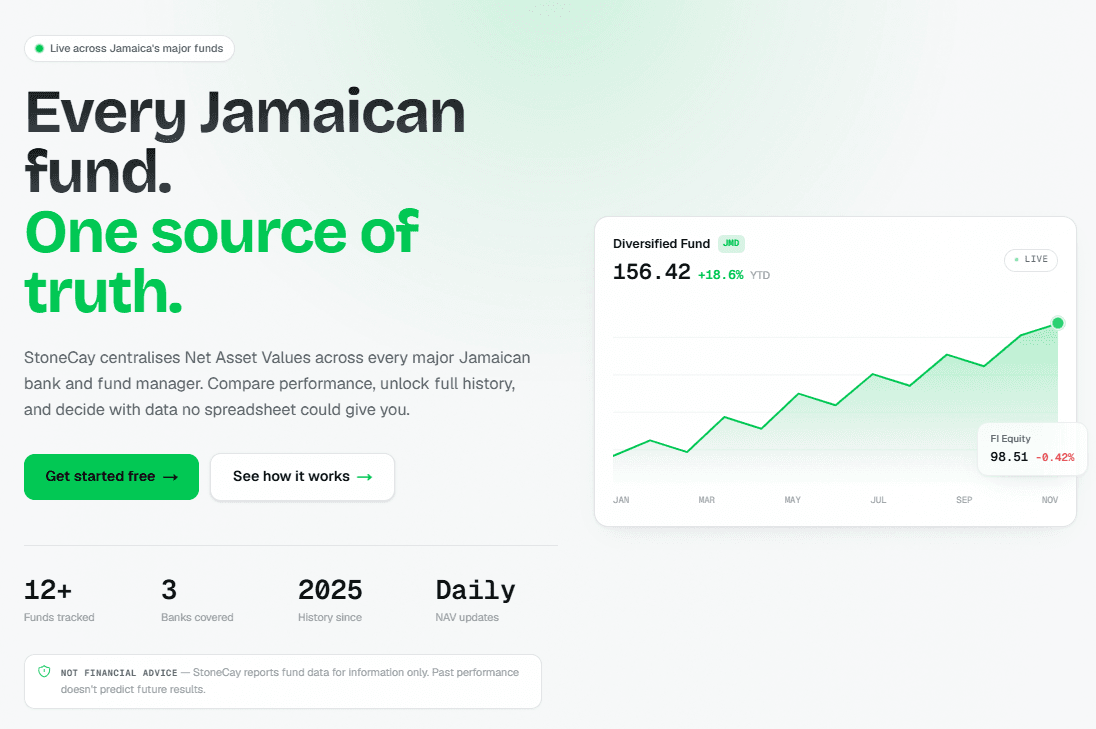
Visit the site → stonecay.com
The Problem That Wouldn't Go Away
When I started investing in Jamaica, the hardest part wasn't choosing a fund. It was comparing them. Every bank publishes its own Net Asset Values (NAVs) on its own portal, in its own format, on its own schedule. Some publish image-only NAVs you can't copy, some update late, and none of them talk to each other.
So if you wanted to answer a simple question, like which fund actually performed best this quarter, you were stuck opening five tabs, copying numbers into a spreadsheet, and hoping you were comparing like for like. There was no single place to see every fund at the same time.
That gap is the reason StoneCay Markets exists.
One Place to See Every Fund
StoneCay Markets is the first centralised platform for tracking the NAVs of Jamaican bank investment and mutual funds. The whole product is built around one idea, which is to put every fund side by side so investors can compare instead of hunt.
Open the dashboard and you see today's NAV for every tracked fund across every institution. One table, one screen, no tab-juggling. The fragmentation that used to cost you an afternoon is gone.
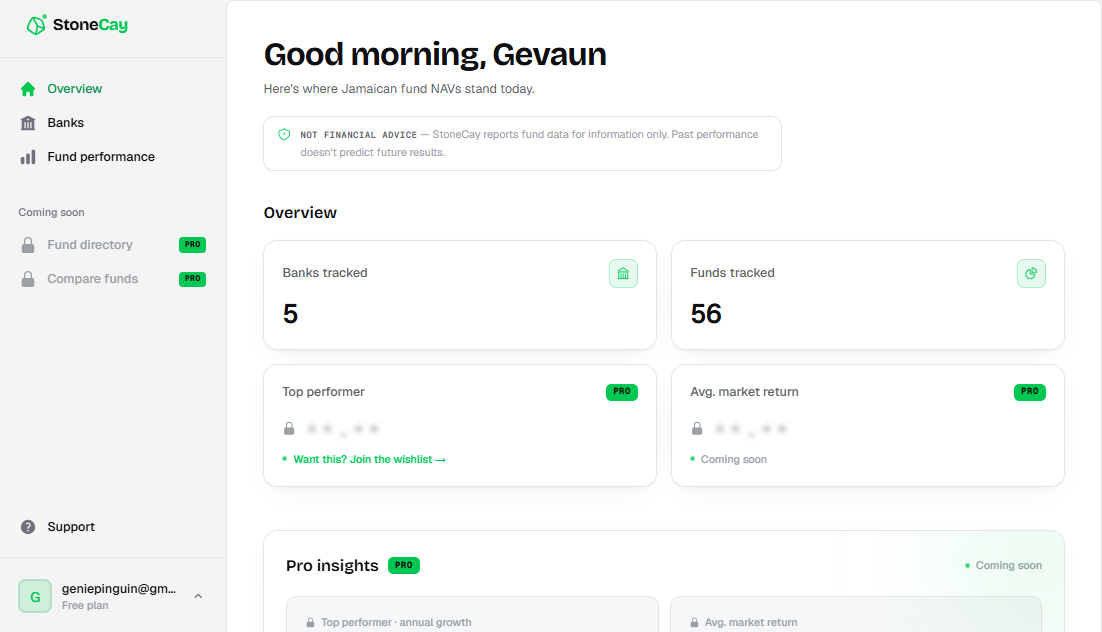
It's focused entirely on Jamaica. It isn't a global tool stretched to fit the local market, but something built for how Jamaican funds actually report.
Built Around Comparison
The free tier already solves the original pain point. Anyone can see today's NAV across all tracked funds in a single dashboard, browse a fund directory with bank and currency details, and get daily data updates.
The Pro tier is for investors who want to go deeper than "what is it worth today". It opens up the full NAV history with interactive charts, so you can see how a fund has grown over time. It lets you compare performance across banks to find which funds deliver the best returns, surfaces growth trends that flag momentum and underperformers, and gives you same-day updates as soon as new NAVs are published. And when you want to run your own numbers, you can export everything to CSV.
The line between the two tiers is deliberate. The free product makes the market visible, and the paid product helps you make decisions with it.
How It Stays Accurate
A comparison tool is only as good as its data, and Jamaican fund data is messy. It's scattered across bank websites and images, in inconsistent reporting formats. The hard part of StoneCay isn't the dashboard. It's keeping the numbers trustworthy and current.
Behind the scenes, a scheduled data pipeline does that work automatically. It gathers published NAVs from each institution, reads and parses them, and writes clean records into a single source of truth. That pipeline has been running in production since early 2025, quietly accumulating the historical record that makes comparison and trend analysis possible today.
On the product side, the experience is fast and secure. Investors sign in, see only what their tier unlocks, and trust that the data they're looking at was published the same day. The technology serves that experience rather than being the point of it.
Where It's Going
The first release is about getting the core right. That means a clear daily dashboard, history and comparison for Pro investors, and a data pipeline that keeps it all honest.
From there, the roadmap deepens coverage of Jamaican funds, adds alerts for meaningful NAV movements, and grows toward portfolio tracking and benchmark comparisons against measures like CPI and the USD/JMD rate. Jamaica first, and done properly, before anything wider.
Final Thoughts
StoneCay Markets started as a personal frustration. I wanted to compare my options and couldn't. Turning that into a product meant focusing relentlessly on one job, making the whole Jamaican fund market visible in one place, and letting every technical decision follow from there.
For investors who mean business, that's the difference between guessing and knowing.